The green-eyed entities' imprisonment in the mirror
Living with 7 vampiresThe green-eyed entities' imprisonment in the mirror is not a passive disappearance but an unstable supernatural state in which the mirror functions simultaneously as cell, threshold, and threat. The entities are confined behind or within reflective surfaces, yet their influence reaches into the physical world: a shadow can seize Y/N and pull Y/N through the glass, while a hand can enter the mirror from outside. Their confinement therefore creates the central contradiction of the state: the mirror restricts the entities, but it does not make them powerless.
Definition and Mechanism
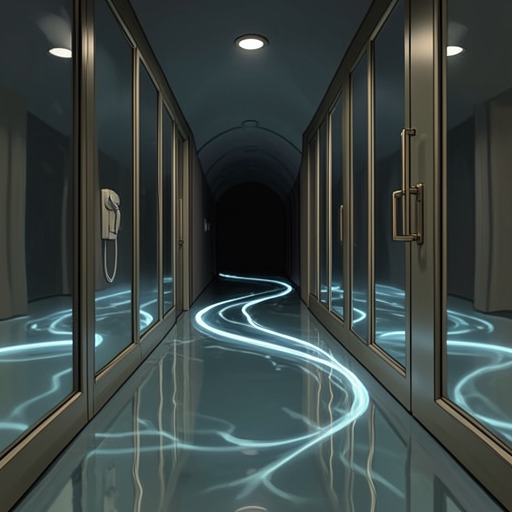
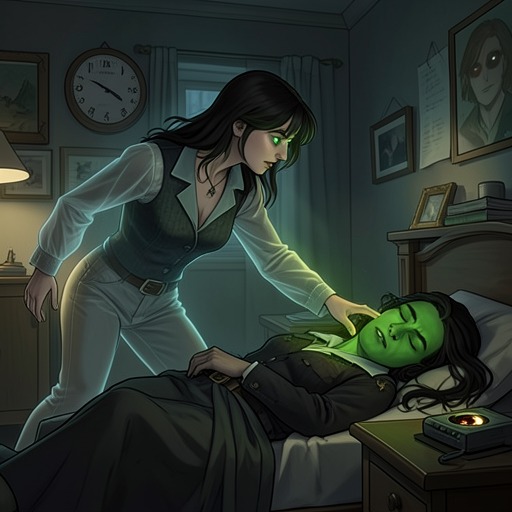
The mirror first appears as a permeable boundary rather than ordinary glass. After Jin’s body falls, a shadow remains standing and holding Y/N’s wrist before pulling Y/N inside the mirror; the surface feels like water, and Y/N finds that Y/N is now within it. This transition establishes that the mirror can absorb a person bodily and can transform a familiar object into an enclosing environment. The act is not presented as a voluntary doorway controlled by Y/N. The shadow retains physical agency over the wrist, making imprisonment through the mirror an imposed condition rather than a neutral form of travel.
The mirror’s permeability works in both directions. When V walks to it and asks whether it is supposed to be that way, V inserts a hand into the surface and the hand passes through. The scene makes the boundary materially active: it yields to intrusion while still maintaining the distinction between the world outside and the space inside. The mirror is thus neither fully solid nor fully open. Its unstable substance enables the entities’ imprisonment, their attempted access to the living, and the possibility that humans may cross the same boundary.
The Entities’ Captivity and Demands
Jin explains that the green-eyed entities want Y/N to set them free and warns Y/N never to trust them. Their condition is therefore defined by captivity and by an outward-directed demand. They cannot simply leave the mirror on their own terms, so they seek an intermediary whose actions might release them. This makes Y/N’s body, knowledge, and decisions strategically important to beings who are otherwise constrained by the reflective enclosure.
The entities’ statements also expand the apparent geography of their prison. Y/N reports that they revealed only that the mirror is not the only entrance. The information is incomplete, but it changes the meaning of the mirror imprisonment: the entities may be confined in the mirror without the mirror being the sole route into their domain. Jimin treats the statement as a problem to be interpreted after the mirrors have been destroyed, suggesting that destroying visible entrances may not eliminate the underlying access system. The warning preserves uncertainty even when the obvious portals are removed.
Choice, Captives, and Coercion
The imprisonment becomes an explicit moral and strategic dilemma when JB identifies himself and points first toward the mirror, then toward the bubble containing the trapped companions. JB presents Y/N with two alternatives: seek answers about Y/N’s real parents and life, or save the people who are keeping Y/N as a prisoner. Y/N rejects the description of being a prisoner, but the scene places personal origins and the immediate rescue of others in direct opposition. The mirror is therefore not only a supernatural location; it becomes the visible side of a choice imposed upon Y/N.
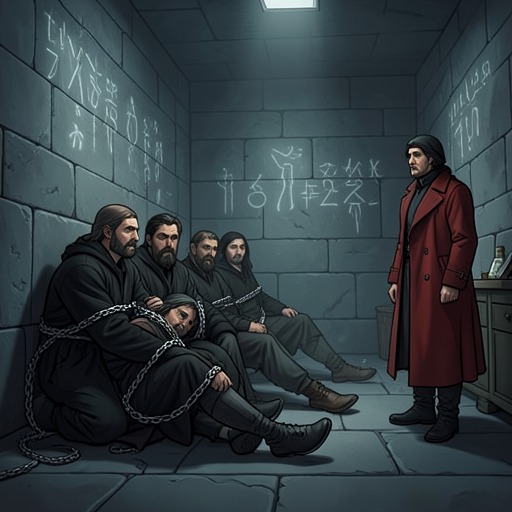
The bubble provides the state’s clearest physical image of confinement beyond the mirror itself. Y/N looks back and sees Jimin and V sitting inside it, with Suga moving while the others do not react. The captives are present and visible, but visibility does not equal access or safety. Y/N leaves the room despite looking back at the mirror, and a faint warning not to trust the others is heard after departure. That recurrence of distrust means the imprisonment is accompanied by competing voices and uncertain testimony: the beings may seek liberation, but their warnings and bargains cannot be accepted at face value.
Spatial Consequences and World-Building
The mirror-bound state is connected to a larger hidden architecture beneath the castle. Jackson reveals that all of this is under the castle, even though the environment appears to be daytime, making the space beneath the Castle appear to possess its own misleading temporal or atmospheric logic. The disclosure prevents the mirror prison from being understood as an isolated room or decorative supernatural object. It belongs to an underground system whose apparent conditions cannot be read by ordinary human expectations.
Across these encounters, the mirror repeatedly changes status. It is a liquid-like surface when Y/N is pulled through, an opening when V’s hand enters it, a repository for the green-eyed entities, and a clue pointing toward routes that may exist elsewhere. The object’s shifting function places it at the center of the story’s spatial uncertainty. Human characters seek to destroy or avoid the mirrors, yet the entities’ claim that the mirror is not the only entrance implies that physical destruction may not end the danger. The material boundary can be damaged without the power behind it being fully contained.
Narrative and Thematic Significance
The imprisonment gives physical form to a conflict over freedom and control. The entities are prisoners who demand release, but they exercise coercion through shadows, bodily seizure, warnings, and forced choices. Y/N, meanwhile, is asked to decide whether to pursue an unknown family history or protect companions who are themselves described as jailers. No position remains morally simple: captivity is claimed by several sides, and each appeal to liberation may conceal another form of domination.
The mirror also externalizes fractured identity and unreliable knowledge. It reflects appearances, yet it conceals the actual location of the entities, the existence of other entrances, and the consequences of release. Y/N’s movement through the glass makes the boundary between self and other, captive and rescuer, and inside and outside physically unstable. The final contrast with Y/N’s later power is significant: after speaking with the self, Y/N breaks a chain merely by moving the right arm, while Gehan appears frightened. Against the earlier state in which a shadow controls Y/N’s wrist and drags Y/N through the mirror, this later gesture marks a reversal from externally imposed restraint toward recovered agency. The mirror imprisonment therefore remains important not only because it confines the green-eyed entities, but because it dramatizes the larger struggle over who can hold, move, define, and finally free whom.